
The Algorithm Has a Name, and It’s Curtis "50 Cent" Jackson
50 Cent hasn't dropped an album in years. He's still winning. That tells you everything about how fame actually works in America.

Last week, 50 Cent did what 50 Cent does best — he made you look. Again.
Curtis Jackson posted his YouTube Music streaming numbers for March 2026 to social media, and the figures were, by any reasonable measure, staggering: 164 million streams in a single month. For context, Jay-Z logged approximately 58.9 million streams over that same period. T.I. came in at 63.7 million. Rick Ross, Diddy, Ja Rule — all outpaced by a man who hasn’t released a proper studio album in over a decade and hasn’t been what you’d call actively rapping for even longer. (It should be noted, Eminem was a glaring omission on this list.)
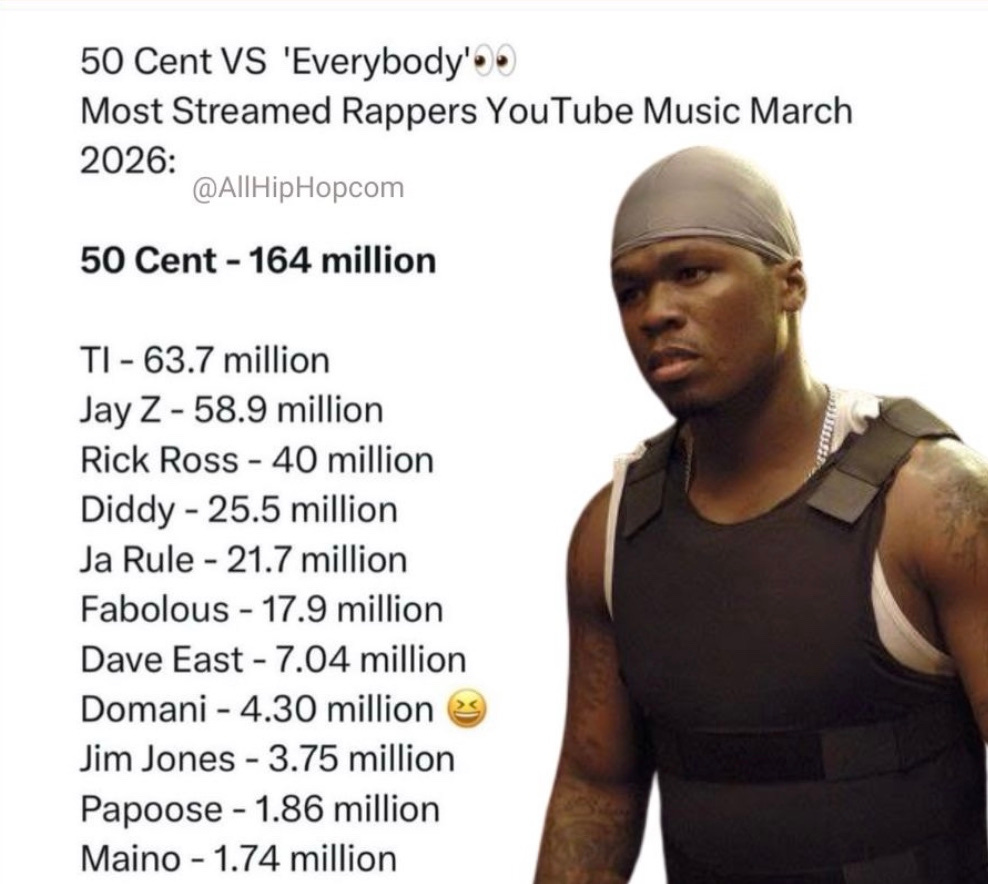
The internet did what the internet does. It laughed, it argued, it amplified. Which, of course, was precisely the point.
I chuckled too. But not at the numbers. I chuckled because I recognized the move. 50 Cent doesn’t post things casually. There is always architecture behind the gesture. And what this particular gesture revealed wasn’t just streaming dominance — it revealed something far more interesting: a man who has mastered the attention economy so thoroughly that he no longer needs music to win a music argument.
Still, I’d be lying if I said I didn’t see something else in that post. A flicker of competitive hunger. The quiet restlessness of a lion who has left the savanna but still watches from the hillside. He may not admit it openly, but 50 Cent has never stopped wanting to be on top of the pile in Hip-Hop. And given the brute-force artistic urgency that defines the current climate — where Kanye West, T.I., Nas, and a new generation of competitors are in constant, vocal creative combat — I imagine part of him wants back in. The challenge, of course, is that the game has changed. You can no longer buy your way to the front of that conversation. You have to earn it through work, vulnerability, and a willingness to be artistically surprised by yourself. That has never been 50 Cent’s preferred mode of engagement.
But let’s back up. Because to understand what those streaming numbers actually mean, you have to understand how Curtis Jackson was built.
Get Rich or Die Tryin’ debuted on February 6, 2003, and sold 872,000 copies in its first week — a seismic number by any era’s standard. The following week it sold another 822,000. It went on to become the best-selling album of 2003, eventually moving more than 13 million copies worldwide and earning a 9x Platinum certification from the RIAA. “In da Club” occupied the number one position on the Billboard Hot 100 for nine weeks. By July 2014, 50 Cent was the sixth best-selling Hip-Hop artist of the Nielsen SoundScan era, with over 16 million albums sold in the United States alone.
These are not the numbers of a rapper. These are the numbers of a cultural phenomenon.
And a cultural phenomenon requires more than talent. It requires infrastructure. In 50’s case, that infrastructure had three names: Eminem, Dr. Dre, and Interscope Records — specifically, the corporate genius of Jimmy Iovine. What they constructed together was one of the most formidable artist launches in modern music history: a compelling street narrative, an undefeated underdog posture, the credibility of a man who had literally been shot nine times and survived, wrapped in the commercial acumen of two of the most successful producers in pop history.
To be clear, this is not to diminish 50 Cent as an artist. He is, without question, one of the great artists of our time. But if you know Hip-Hop the way I know Hip-Hop, you know that great artists are plentiful. Megastars — those are a different category entirely. And to reach that altitude, even the most naturally gifted artist requires the right ecosystem at exactly the right moment. 50 had both.
He also had something else. Something that no label can manufacture and no producer can engineer: crossover appeal.
Race is not a comfortable variable to introduce into a conversation about streaming numbers. But it would be intellectually dishonest to ignore it, because it is, in fact, central to understanding how an artist like 50 Cent achieves and sustains the kind of mainstream dominance his March numbers represent.
American popular music has always rewarded Black cultural innovation most handsomely when it is delivered through a container that the mainstream — which is to say, historically, white America — finds accessible, exciting, and safely transgressive. This is not a conspiracy theory. It is a documented pattern. Before Elvis Presley sold the country on rock and roll, Chuck Berry, Sister Rosetta Tharpe, Little Richard and Big Mama Thornton had already invented it. The Rolling Stones will tell you themselves that they were translating the blues. Run-DMC, understanding this dynamic with remarkable clarity, titled their second album King of Rock and opened their first video “Rock Box” with electric guitar. Michael Jackson, seeking entry onto MTV, placed Eddie Van Halen on “Beat It.” These were not accidents of taste. They were strategic acts of cultural translation. They knew it was necessary to win and win big.
50 Cent ran a version of this same playbook — not by diluting his Southside Jamaica, Queens identity, but by packaging it in a way that felt, to mainstream audiences, like the most thrilling thing they had never been allowed to see up close. His story — shot nine times, left for dead, blackballed by his label, resurrected by the two biggest names in rap — was, as I have said before, a literal movie. And American mainstream culture, particularly white American mainstream culture, has always had a complicated, voracious appetite for that kind of narrative: the invincible Black man from the streets, fearless, undefeated, slightly dangerous, and somehow still here.
Eminem, for his part, occupies a different position in that same ecosystem. Where 50 is the object of fascination — the outsider they marvel at — Eminem is the mirror. He is the son, the brother, the rebellious bad boy next door, rendered relatable by his proximity to whiteness even as he raps about experiences that are anything but suburban. Together, the two men represent a kind of dual axis around which Interscope built a commercial empire. And the genius of it — the thing that neither of them gets enough credit for — is that neither of them compromised their artistic DNA to do it.
Now here is where the streaming numbers get genuinely interesting.
In an era when the music industry is openly grappling with what streaming actually measures — popularity versus artistry, catalog depth versus cultural immediacy — 50 Cent’s March figures illuminate something specific. He is, as he himself declared in the caption accompanying his post, “the Algorithm.” And he is not wrong. He has spent the better part of the last decade mastering the attention economy: building the Power television franchise into one of the most-watched series in Starz history, maintaining a relentless social media presence that functions less like personal branding and more like appointment television, and sustaining a fanbase whose loyalty operates closer to a religious denomination than a consumer relationship.
His fans — much like Nicki Minaj’s Barbz — do not waver. They will not concede that Ja Rule has had a career of genuine longevity and artistic merit. They will not hold 50 accountable for his missteps. They are, in the language of media economics, an engaged base — and in the streaming era, an engaged base is worth more than casual listeners by several orders of magnitude.
This is not a critique. It is an observation. Every megastar, from Taylor Swift to Beyoncé to Jay-Z himself, has a version of this. The difference is that 50 built his without releasing music. He built it on story, personality, and the ancient human compulsion to watch someone who refuses to lose.
But here is what that comparison to Jay-Z, T.I., and the others doesn’t tell you — and what I think is important to name clearly, especially in a moment when T.I.’s son Domani is working to establish himself as a serious artist in his own right.
Streaming numbers are a measure of reach, not of depth. They tell you how many people pressed play. They do not tell you what those people felt when the song ended. “In da Club” will be played at birthdays until the end of time. Get Rich or Die Tryin’ will always make you feel something specific — a particular brand of early-aughts invincibility, a memory of bass in a car at night, a time when Hip-Hop felt like it was simultaneously everywhere and dangerous. That is real. That is earned. That is legacy.
But Jay-Z’s Reasonable Doubt is a meditation on moral compromise that grows more resonant the older you get. T.I.’s King is a masterclass in Southern rap architecture. And Domani — still finding his footing, still learning to inhabit his own artistic voice in the long shadow of his father — represents something that streaming algorithms have never known how to value: potential in process. Becoming. The slow, intentional burn.
50 Cent’s genius is the blockbuster. The event film. The franchise. And there is absolutely nothing wrong with that. Some of the most important art ever made has been popular art. But the romantic comedy, the slow-burn thriller, the quiet film that you think about for years — these are not lesser forms. They are different frequencies. And a music culture that reduces its artists to a single metric — streams per month, first-week sales, social media impressions — risks losing its ear for the full range of what music can do.
50 Cent is 50 Cent. He has earned every number, every streaming milestone, every victory lap. He is his own solar system — self-sustaining, with his own gravity. You cannot ignore him. You cannot dismiss him. And every birthday, every party, every moment that requires a certain kind of swagger, you will reach for him.
But greatness, in art, is not a competition. The megastar and the poet serve different hungers, and both hungers are real. The only artists who truly lose are the ones who stop being honest — about who they are, what they’ve lived, and what they’re trying to say.
Numbers don’t lie. But they don’t tell the whole truth, either. Never have.

Chuck “Jigsaw” Creekmur is the co-founder of AllHipHop.com and one of Hip-Hop’s most respected cultural voices.
Great read